Mountains and the Environment
Changes to the Environment have a profound impact on the mountains and accelerate change locally and globally
Climate change is the key challenge for the mountains and nowhere is this as visible as with the melting and retreating of the once magnificient Alpine glaciers.
Why does Climate Change matter?
Climate change is having a profound and highly visible impact on the Alps, which are often described as an early warning system for global warming. Rising temperatures are causing Alpine glaciers to melt rapidly, with many having already lost more than half their volume since the mid-20th century and some expected to disappear entirely in the coming decades. This glacier loss affects not only the landscape but also long-term water supplies for major European rivers such as the Rhine, Rhône, Po, and Danube. Warmer winters are also reducing snowfall, shifting precipitation from snow to rain at lower elevations, and causing snow to melt earlier in the year, which disrupts ecosystems and threatens winter tourism that depends on reliable snow cover. At the same time, thawing permafrost is destabilizing mountain slopes, increasing the frequency of rockfalls, landslides, floods, and debris flows, while meltwater accumulation raises the risk of glacial lake outburst floods. Alpine plants and animals are being forced to migrate uphill to cooler conditions, but species adapted to high altitudes are running out of space and face growing extinction risks. Although increased glacier melt may temporarily boost river flows, long-term water availability is expected to decline, with consequences for agriculture, hydropower, drinking water, and ecosystems far beyond the mountain region. Together, these environmental changes are reshaping Alpine economies, infrastructure, and cultural traditions, placing significant pressure on communities that have long depended on stable climatic conditions.
Rhone glacier is a sad tale of how climate change impacts and changes the Apls
The Rhone glacier is the birthplace of the Rhone river which is the key south western "drainage" system and runs from the Swiss Alps to the French mediterranean coast, reaching the sea in the Camargue region just west of Marseille. The glacier sits between the Furka and Gimsel passes, the Furka pass road rises just next to it past the hotel Belvedere, or used to as the glacier is long gone now.
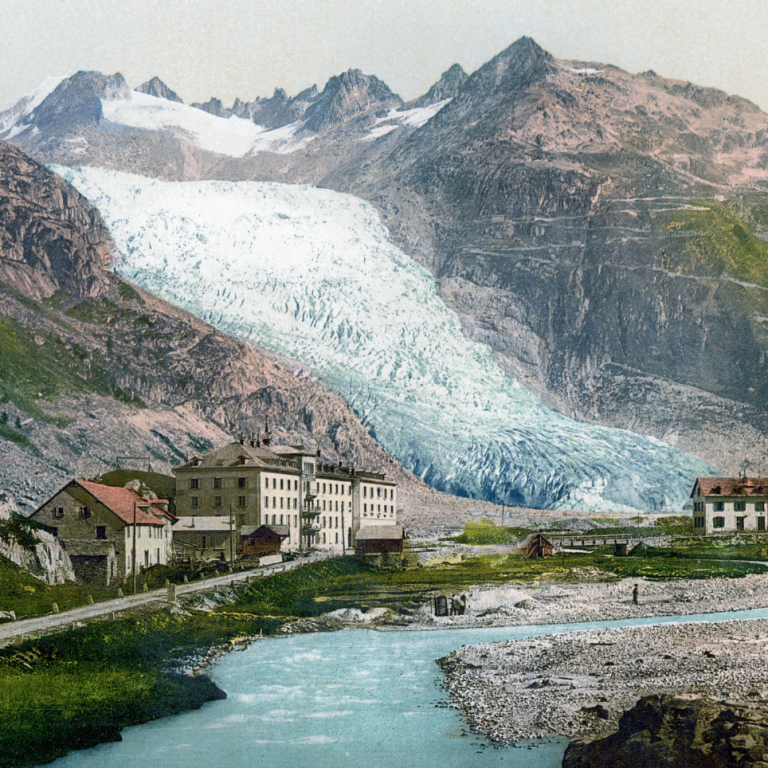
Rhone glacier in the 19th century
The glacier used to be magnificent in all aspects and came right down into the valley, like a tongue from an open mouth. A demonstration of the power and beauty of nature.
This picture shows the village of Gletsch looking up onto the Furka pass road. The Belvedere Hotel is visible on the upper switchback which must date this picture back to the 1880's. This was also the advent of glacier tourism and wealthy people flocked to the mountains to admire the awe inspiring nature.
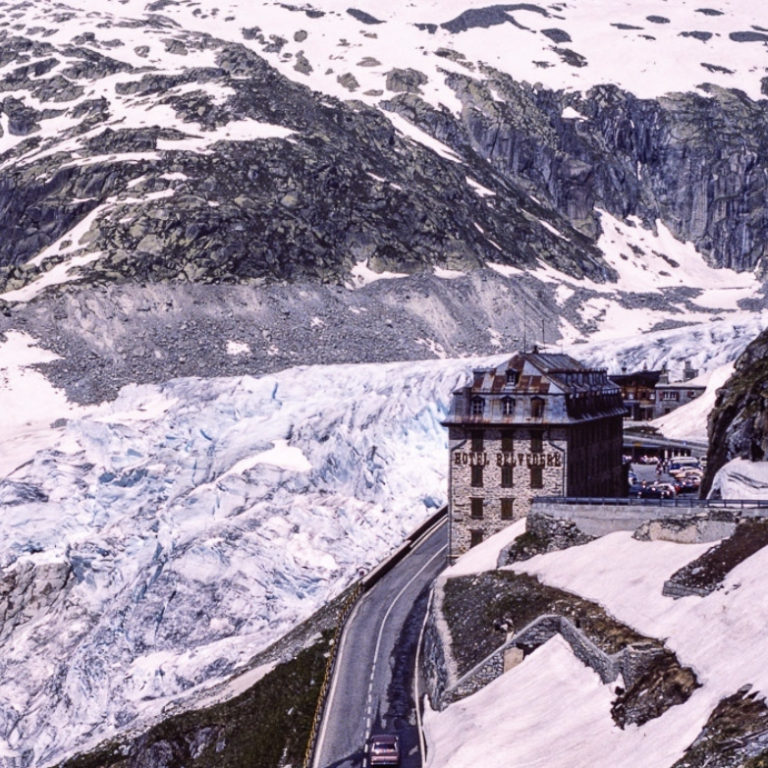
Rhone glacier in the 20th century
The construction of the Hotel Belvedere helps to tell the story of the once mighty Rhone glacier. When it was built, people flocked here to see nature in its imposing raw form but from a safe distance and in comfort. The James Bond 007 franchise filmed at the Furka pass in the Goldfinger film in July 1964 and the ice then reached up to the hotel till the turn of the millenium. But the retreat of the ice was already accelerating as global pollution and gasses responsible for climate change were released exponentially.
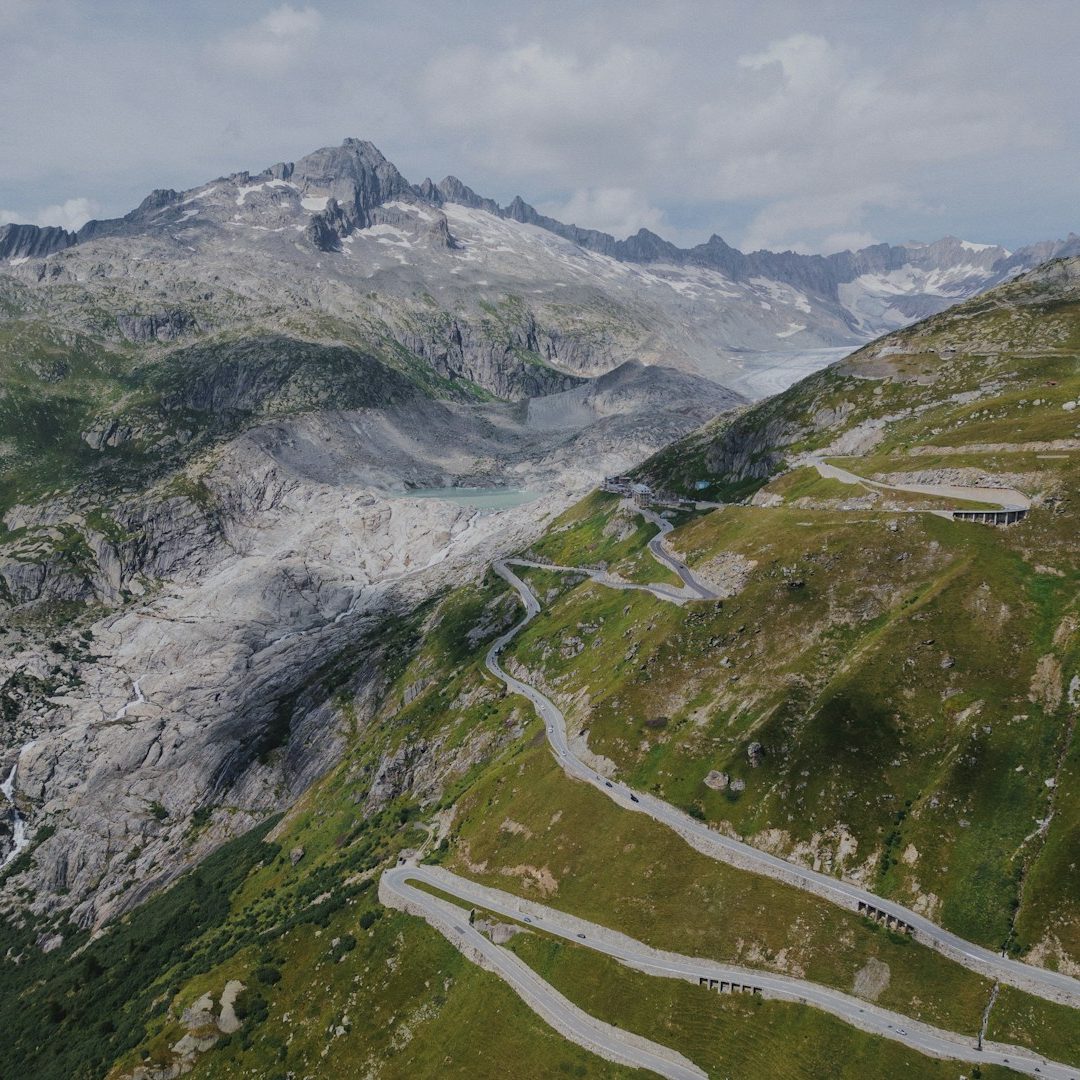
Today, where once a mighty glacier stood, scree, rock and boulders dominate. The glacier has retreated high up the valley and it is melting fast. The hotel that was built in 1882 during the Victorian time is closed since 2015 as there is no glacier view to be had and no marvelling at nature's wonder and the blue shimmering ice.
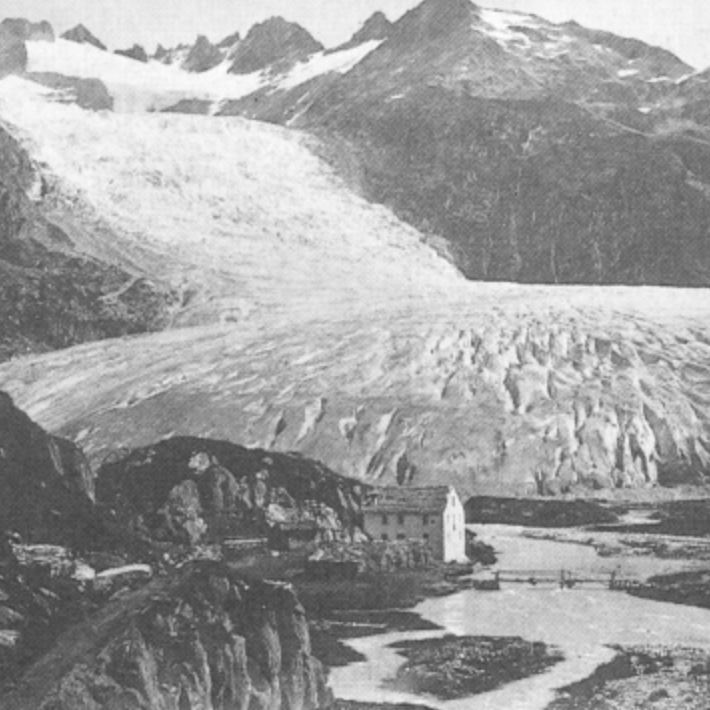
Mini Ice Age - 1820-1860
The Rhone glacier probably reached its maximum expansion during the mini ice age in the mid 19th century. This image shows the glacier looming large over the valley villages; the Furka pass road was not been built yet. The pass road was constructed between 1864 and 1866 which must date this image around the early to middle of the 19th century.
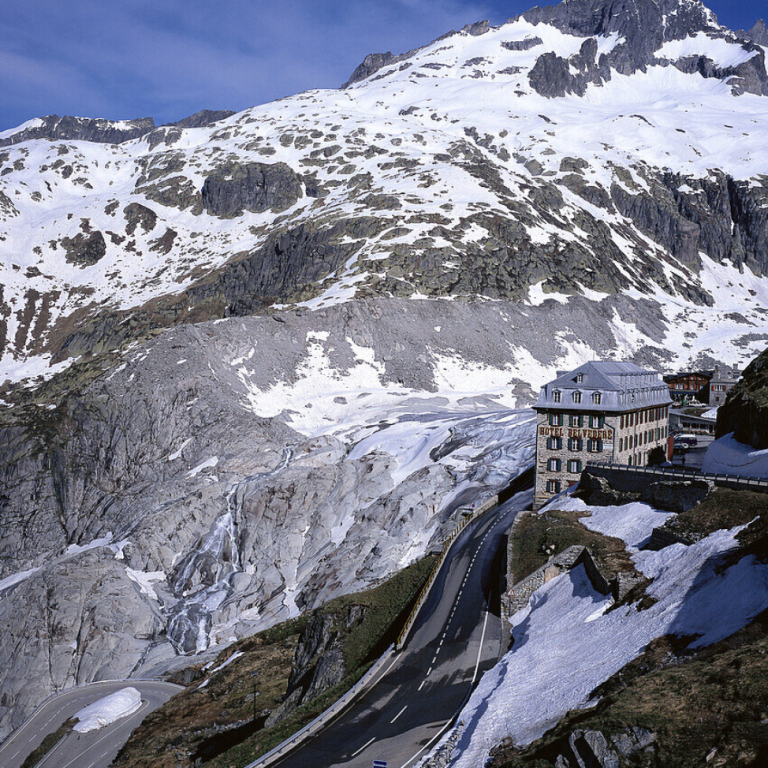
Rhone glacier today
In sharp contrast to the mid 19th century, today the hotel stands as reminder of the changing environment. No ice, no blue shimmer in the sunlight, tourist wanting to admire nature's wonders have been replaced by scientists measuring the patient's slow death, unable to help. The ice is melting ever faster and even harsh winters with plentiful snowfall can't compensate for the increasingly warm summers. The glacier is dying which must fill anyone who loves the mountains with a profound sadness.
This is not just a tale of disappearing ice
All ecosystems are built around stability. Our current ecosystem developed over a period of 60–70 million years, beginning when mammals appeared after the extinction of the dinosaurs. That is a long time during which, based on increasingly predictable weather and environmental stability, plants, animals, and nature in general were able to develop. By contrast, climate change is occurring rapidly. The environmental changes of the last 100 years alone outpace any historical precedent in human history, and the fear underlying many apocalyptic predictions is that humans may not be able to innovate fast enough to keep up with the speed of these changes. The fact that humans created this situation and are now desperately scrambling to contain the unintended consequences of our way of life is an ironic side note. Unless people are denying any responsibility in the first place.
But this is not just about the disappearance of the Rhône Glacier, it serves only as a sad example; this is about more widespread changes in climate leading to the loss of glaciers everywhere and the consequences this is already having for downstream water management. The snowpack acts like a giant sponge, absorbing water in winter, storing it and releasing a steady and predictable flow during the warmer months. In doing so, in the case of the Alps it regulates water supply through the Rhône in the southwest, the Po in the southeast, the Rhine in the northwest, and the Danube in the northeast of the Alps. This represents a vast water supply on which people and agriculture depend. Instability leads to flooding and drought in equal measure, causing water shortages and failed harvests that threaten food security. A glacial water supply system is not just present in the Alps but in any high mountain region across the globe.
The impacts within the mountains themselves are equally profound. Animal habitats are changing, increased rainfall and looser ground are triggering more landslides, and livelihoods that depend on tourism face an uncertain future as seasonal weather becomes less predictable. Local water management for power generation will struggle to cope with increasingly erratic flows, and communities will face greater risks from flooding.
The ability of people and nature to adapt to new situations is well documented, but it is the speed of change that poses the greatest threat. Humans have responded to climatic changes through increasingly artificial ways of living and greater urbanization. We move between air-conditioned homes, cars, offices, and shopping malls, becoming ever more removed from the natural world and increasingly unaware of the systems that sustain us. Technology provides a comfort blanket that shields us from the consequences of our own actions. Nature, on the other hand, responds through the survival of more resilient plants and animals, a process that ultimately reduces biodiversity. History suggests though that nature will likely survive the changes humans have unleashed. Human existence, however, has so far been brief in evolutionary terms, and whether our technological approach to combating change will be successful remains unproven. There is considerable room for doubt about whether we will make it through.
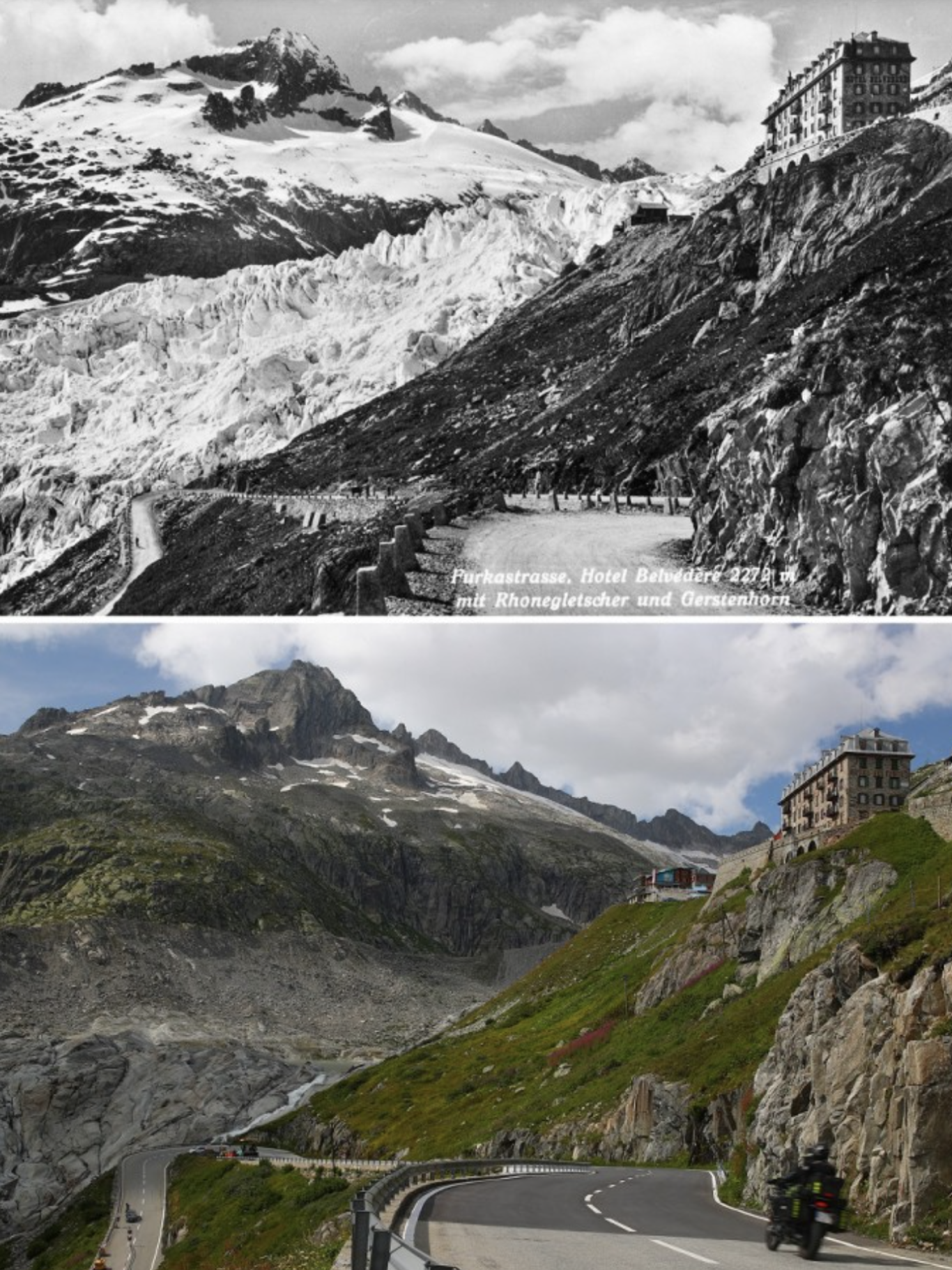
Rhone glacier from the Furka Pass road in 1938 above and 2019 below: All the ice has gone and the abandoned hotel stands like a mourner overlooking a graveyard of rock left behind by the dying glacier.
Cycling and climate change
People often say that the weather in the Alps is unpredictable. But what does that really mean?
Weather patterns in the Alps are becoming warmer and wetter. Average temperatures in the region are rising faster than the global average, a trend that is particularly noticeable at higher altitudes. Precipitation is becoming more uneven, and when it does rain, it tends to be heavier. Intense rainfall events are increasing, especially in summer and autumn, which raises the risk of flooding, landslides, and debris flows. At the same time, longer dry periods and more frequent heatwaves are increasing drought stress. Storm patterns are also evolving, with stronger storms bringing heavier rainfall and more powerful winds. This shift from steady, predictable weather toward extremes is one of the most significant changes occurring in the Alps.
As a result, riding in the Alps during summer is becoming increasingly weather-dependent, making preparation essential. Even on day rides, you may need more clothing than in the past, including not only a rain jacket and overshoes but also warm layers, as hypothermia can be a real risk during storms. Arm and leg warmers or a lightweight, packable insulated jacket can make a critical difference. From a bike-handling perspective, riders should consider their confidence in wet conditions: do you know how to adjust braking distances and tyre pressure for rain, and which tyres perform best on wet surfaces? These are important questions, and this video offers some helpful answers.
If you are caught in a storm, descend to a sheltered location as quickly as possible and avoid exposed ridges, which increase the risk of lightning strikes. Follow the 30–30 rule: if the time between lightning and thunder is 30 seconds or less, seek shelter, and remain there for 30 minutes after the last thunder is heard. Never take shelter under a tree.
Snow presents a particular hazard for cycling and if snow begins to fall, seek shelter immediately. If you must descend in snowy conditions, do so very slowly, use only the rear brake, and consider unclipping one foot to improve balance.
Before starting a route, it is therefore crucial to familiarize yourself with rest stops and shelters along the way, identify places where you can obtain food, and know who to contact in case you need assistance or rescue.
Conversely, during periods of intense heat, hydration and energy management become key. Take regular breaks and avoid overheating. Know the locations of water sources along your route, and remember that many chapels or churches have taps where you can refill bottles. On especially hot days, carrying an additional pack with a hydration bladder may be a wise choice.
Above all, always check the weather forecast and available webcams before heading out.
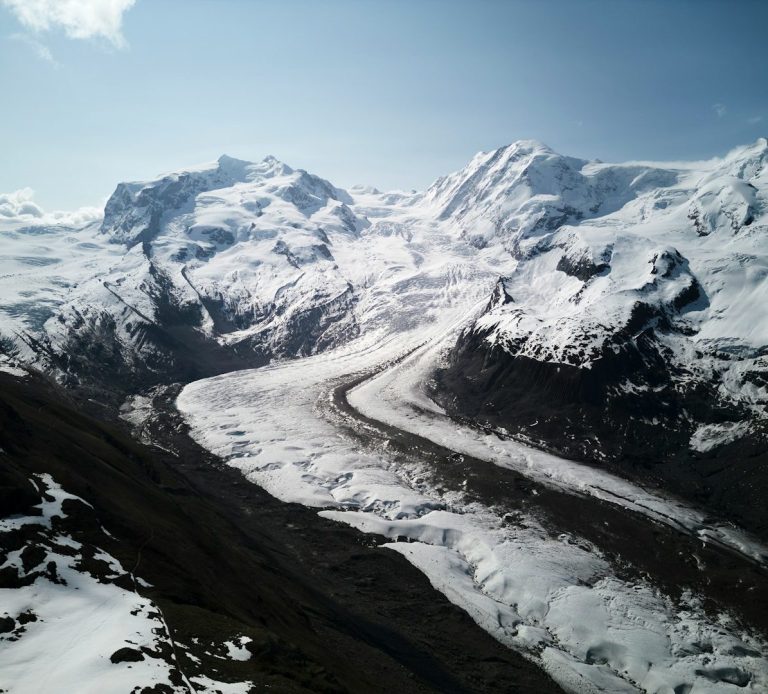
Research and info about Alpine glaciers
The University in Zurich is participating in monitoring glaciers and permafrost in Switzerland - more here. Also, GLAMOS is the Swiss glacier monitoring service - more here.
There is also some research and information from Austria about the losing battle glaciers are fighting.
This site gives specific information about the glaciers of the Mont Blanc in France
This is an informative video about the state of the Rhone glacier.