The history of the Alps gives meaning to riding there
The Alps are unique because they combine extraordinary natural scale with an exceptionally rich human history. What makes them special is not simply their height or beauty, but the way nature, culture, history and human movement have been intertwined here for thousands of years.
Within relatively short distances, the landscape changes dramatically—from vineyards and valleys to forests, alpine meadows, glaciers and towering peaks. Beneath this scenery lies an equally remarkable geological story. The Alps were shaped over millions of years by the collision of tectonic plates, erosion, glaciers, rivers and landslides. The landscape we see today is, in many ways, a visible record of geological time. But the Alps are more than a geological monument. They have also been one of Europe's great barriers and, paradoxically, one of its great crossroads.
For thousands of years, the Alps divided northern and southern Europe. Their enormous peaks, deep valleys, glaciers and unpredictable weather made movement across them difficult and dangerous. Before modern roads, railways and tunnels, travellers had to cross the mountains on foot or with pack animals, following narrow trails and passes. Snow could close routes for months, while avalanches, rockfalls and storms could turn a journey into a life-threatening undertaking.
Yet people never simply accepted the Alps as an impassable wall. Wherever the terrain allowed, routes were established through the mountains. Prehistoric trails became trading routes; mule tracks became roads; and important passes became Roman roads, military routes, postal roads and eventually modern highways and railways.
A pass could connect valleys that were otherwise almost completely isolated. It could bring together different languages, cultures and economies and provide a route for merchants, pilgrims, soldiers, migrants and ideas to move between northern and southern Europe. The mountains therefore became both a boundary and a meeting place.
A landscape of military importance
The strategic importance of the Alps arose from the same geography that made them difficult to cross. There were only a limited number of practical routes through the mountains, making the major passes strategically priceless. Whoever controlled a pass could influence the movement of armies, supplies and trade.
The Romans understood the importance of these routes, as did medieval rulers and the European powers that followed. Perhaps the most famous example is Hannibal's crossing of the Alps in 218 BC during the Second Punic War. By crossing what seemed to be a natural defensive barrier, Hannibal turned the geography of the Alps to his advantage and entered Italy from an unexpected direction.
More than two thousand years later, Napoleon demonstrated the same principle. In 1800, he led the French Army of Reserve across the Great St Bernard Pass into northern Italy, allowing him to surprise Austrian forces and contributing to his victory at the Battle of Marengo. The famous paintings show Napoleon crossing the Alps on horseback, although the reality was considerably less dramatic: he travelled by mule, while his artillery had to be hauled through the mountains with enormous effort.
The military significance of the Alps continued into the twentieth century. During the First World War, Italian and Austro-Hungarian forces fought at extraordinary elevations in snow, ice and rock. The environment itself became an enemy, with frostbite, avalanches and exposure sometimes proving as deadly as combat.
During the Second World War, the Alps remained strategically important. Switzerland's mountainous geography became central to its defensive strategy, while the routes through the mountains remained vital connections between Germany, Austria, Italy and France.
The Gotthard is perhaps the clearest example of this evolution. Its position made it one of the great routes between northern and southern Europe and gave it both commercial and military importance. Today, enormous tunnels pass beneath the mountains, culminating in the 57-kilometre Gotthard Base Tunnel, which effectively allows modern transport to bypass much of the historic mountain crossing.
The progression is remarkable. The Alps were first an obstacle, then tracks became routes through the obstacle, the passes became military objectives, roads and railways made those routes easier to cross and finally modern tunnels now pass beneath the barrier itself.
A hard place to live
The same mountains that have fascinated travellers have also made life difficult for those who have lived there for generations.
For centuries, Alpine communities faced long and dangerous winters, limited agricultural land, isolation and the constant threat of avalanches, landslides and floods. Steep slopes and high elevations meant that usable farmland was scarce. Families had to make the most of every available patch of land, often developing terraces, irrigation systems and seasonal grazing.
Winter required careful preparation. During the short summer, people had to grow crops, cut hay, collect firewood and preserve food for the months ahead. A poor harvest could have consequences that lasted throughout the winter.
Much of Alpine life also depended on hard physical labour. Hay had to be cut and carried on steep slopes, forests harvested, animals moved between seasonal pastures and food preserved for winter. The traditional practice of transhumance—moving livestock between valley settlements and high summer pastures—was an essential part of this way of life.
Isolation added another layer of difficulty. Before modern roads and tunnels, some villages could be cut off for weeks or months by snow. Access to markets, doctors, education and outside news was limited. Yet these hardships also created a distinctive culture of resilience, cooperation and adaptation.
Every beautiful Alpine road passes through a landscape that was once a place of survival. The smooth tarmac of a modern mountain pass can conceal the extraordinary effort that was once required simply to cross the same terrain. The road may now be a playground for cyclists, but for earlier generations the mountain represented food, danger, isolation, work, trade, migration and sometimes survival itself.
The mountains shaped the people. The Alps did not simply provide a setting for human life; they actively shaped the culture of the people who lived there. Isolation allowed distinctive languages, dialects, customs and traditions to develop. Even neighbouring valleys could develop different identities because the mountains made communication difficult. At the same time, communities situated on major passes were exposed to merchants, soldiers, pilgrims and travellers and therefore experienced far greater cultural exchange. The Alps consequently produced both isolation and connection.
The seasons also dictated the rhythm of life. People had to organise their lives around the movement of animals, the cutting of hay, the opening and closing of passes and the arrival of winter. Agriculture, architecture, food and festivals all evolved in response to these conditions.
Traditional buildings were designed around the practical demands of snow, cold, steep slopes and limited materials. Food traditions developed around what could be produced locally and preserved through the winter. Dairy farming became particularly important in many regions because alpine meadows were better suited to grazing than to growing crops.
Even folklore was influenced by the mountains. Before modern science, avalanches, storms, glaciers and strange sounds echoing through valleys could appear mysterious and frightening. The Alps consequently became associated with dragons, spirits, giants, witches and other supernatural beings.
Over time, however, the way people perceived the mountains changed. For many earlier generations, the Alps represented danger, hardship and isolation. From the eighteenth and nineteenth centuries onwards, the Romantic movement increasingly portrayed them as places of beauty, freedom, sublimity and spiritual experience. Mountaineering and tourism followed, and eventually skiing, hiking and cycling transformed the relationship between people and the mountains again.
The Alps gradually changed from a place people primarily had to live with into a place people wanted to experience.
A landscape with layers of history
This history is still visible throughout the Alps. Roman roads, medieval settlements, fortifications, old mule tracks, churches, farms, railways, tunnels and modern roads coexist within the same landscape. The mountains therefore contain layers of human history that can sometimes be experienced within a single journey.
This is what makes the Alps so different from simply looking at a beautiful mountain range. The landscape has a memory.
A mountain pass may once have been a prehistoric migration route, a Roman crossing, a medieval trading road, a military route or a place where generations of local people travelled with their animals. A village may reflect centuries of adaptation to the climate and terrain. A tunnel may represent the latest stage in humanity's continuing attempt to overcome the barrier of the mountains.
This is where cycling becomes particularly interesting. When you cycle in the Alps, you are not simply moving through beautiful scenery. You are physically travelling through a landscape shaped by millions of years of geology and thousands of years of human history. Every climb becomes part of that story.
The road beneath your wheels may follow an ancient route through the mountains. The pass ahead may once have been crossed by merchants, pilgrims, soldiers or migrants. The villages you pass through reveal how generations learned to live with the terrain. The fields, forests and meadows show how people adapted agriculture to an environment that was never particularly forgiving.
And cycling allows you to experience these things differently from travelling by car or train. You move slowly enough to see the landscape change. You feel the gradient. You experience the weather and altitude. You notice the transition from one valley to another and, sometimes, from one language and culture to another.
You don't simply see the mountain—you experience the effort required to cross it. This physical effort creates an unusual connection with the history of the landscape. Of course, climbing a pass on a modern bicycle bears little comparison with the hardships faced by earlier generations. But the fundamental geography remains unchanged. The gradient is still there. The distance between valleys is still there. The mountain still determines the route.
And this creates a powerful contrast. For earlier generations, crossing the mountain was often a necessity. Today, we cross it voluntarily, seeking challenge, adventure and beauty.
A route created because people had to cross the mountain has become a road people travel because they want to experience it. That transformation is at the heart of what makes Alpine cycling so compelling.
The Alps are more than a cycling destination
Cycling in the Alps therefore becomes something more than a sporting activity. The physical challenge connects you to the geography; the geography connects you to the history; and the history gives meaning to the landscape.
The mountains were once feared as barriers. They became routes of migration and trade, corridors for armies, homes for communities and subjects of myth. They were gradually conquered by roads, railways and tunnels, and eventually transformed into destinations for exploration and recreation. Today, the cyclist becomes the latest traveller in this long story.
You are riding through a landscape where geology lies beneath your wheels, history is written into the roads, culture lives in the villages, and human endeavour is visible in every pass, bridge and tunnel.
Perhaps this is what makes cycling in the Alps truly unique. You do not simply ride through the landscape. You participate in it.
Every climb is a confrontation with the geography that shaped European history. Every pass is a reminder of the people who crossed these mountains before you. Every village reveals how generations learned to survive here. And every road represents another stage in humanity's attempt to overcome, understand and connect the mountains.
The Alps are therefore not merely a place where cycling happens, they are what gives cycling its meaning there.
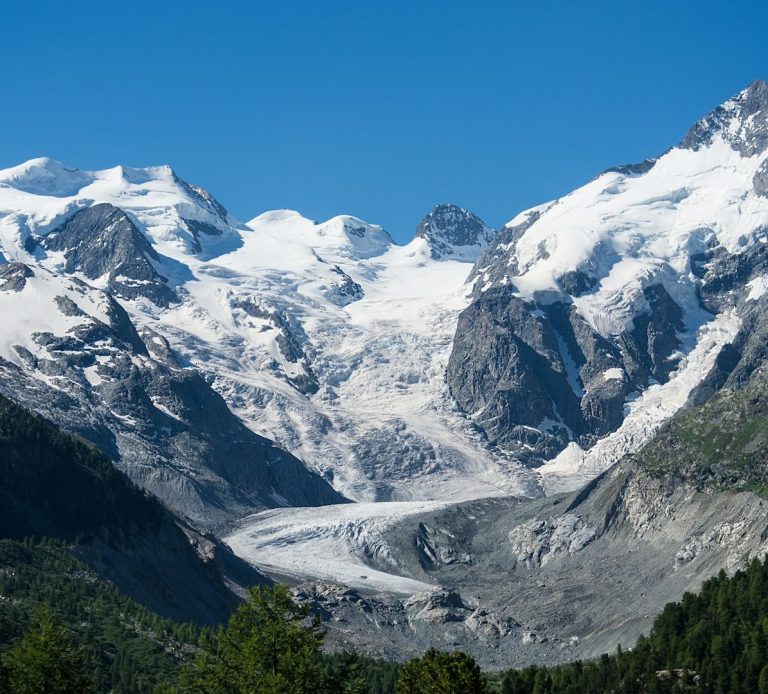
Mountains and the environment
Changes to the Environment have a profound impact on the mountains and accelerate change locally and globally. Climate change is the key challenge for the mountains and nowhere is this as visible as with the melting and retreating of the once magnificient Alpine glaciers.