Spain - Mallorca
Mallorca is probably the most famous cycle region in Spain. This is a wonderful island with great weather, great scenery and a laid back feel.
The Island
Cycling in Mallorca has experienced a huge boom, so much so that many riders are now looking for other cycling destinations in Spain—such as Girona, the Costa Verde, Andalucía, and the Canary Islands, to name just a few. Yet in many ways Mallorca remains the original cycling destination. Being an island gives it a relaxed atmosphere, and the extensive cycling infrastructure is a major advantage.
The Serra de Tramuntana in the north is where most of the climbing takes place and Port de Sóller/Sóller is the best base to explore the mountains. As Pollença and Alcudia offer access to flatter rides, many cyclists base themselves there which might make them feel overrun by cyclists. Port de Sóller is less busy and involves more climbing, as it sits in a cove “beyond” the mountains. All three routes out of Port de Sóller require climbing: either the Puig Major, the Coll de Sóller, or the beautiful and quieter coastal road toward Valldemossa.
Nearly all of the climbs—not even Sa Calobra / Coll dels Reis or Puig Major—are harder than Category 2 climbs. As a result, riding here is less about conquering a single major climb and more about the overall routes. My notes are based on being based in Port de Sóller, and a more detailed description of the town can be found under “Travel Destinations.”
If you visit in spring—March to May—it is a great place to rebuild fitness after a winter of wet roads and hours on the turbo trainer. Your fitness may not yet be at its peak, but the climbs are shorter than in the Alps, and the constant ups and downs feel enjoyable rather than brutal.
If you come in autumn, Mallorca is a wonderful place to extend the riding season and soak up the warmth and spectacular scenery that make cycling such a special sport—before the inevitable return of wet roads and the turbo trainer. 🚴♂️
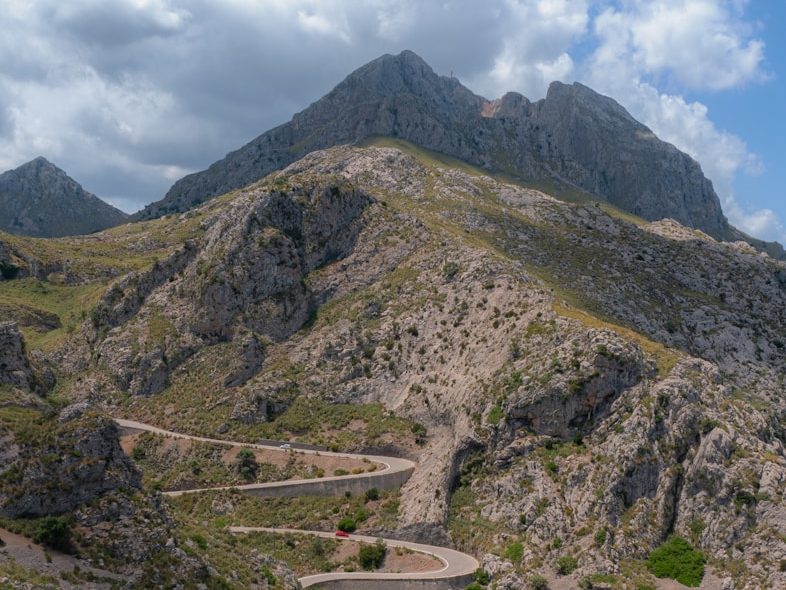
Sa Calobra and Puig Major
Famous climbs
This is a great route involving the two most famous climbs on the island: Puig Major which is the highest climb and the Sa Calobra climb which is the most spectacular climb on Mallorca.
Leaving Port de Sóller, the road joins the Ma-10, where the climb begins. This 14.4 km ascent gains 843 m of elevation, with gradients that rarely exceed 8%. It is a lovely climb—flowing and steadily rising above the Sóller Valley through forests of pine and olive trees. Smoke rising from smallholders burning wood in the valley below adds to the atmosphere, filling the air with its distinctive scent. The summit comes just after a large, cavernous tunnel cut through the enormous cliffs that tower alongside the climb. A short descent then brings you to the Gorg Blau Reservoir and the turn-off to Sa Calobra at the Acueducto de Escorca. The ascent to Coll dels Reis is short and lies in the shadow of Puig Major.
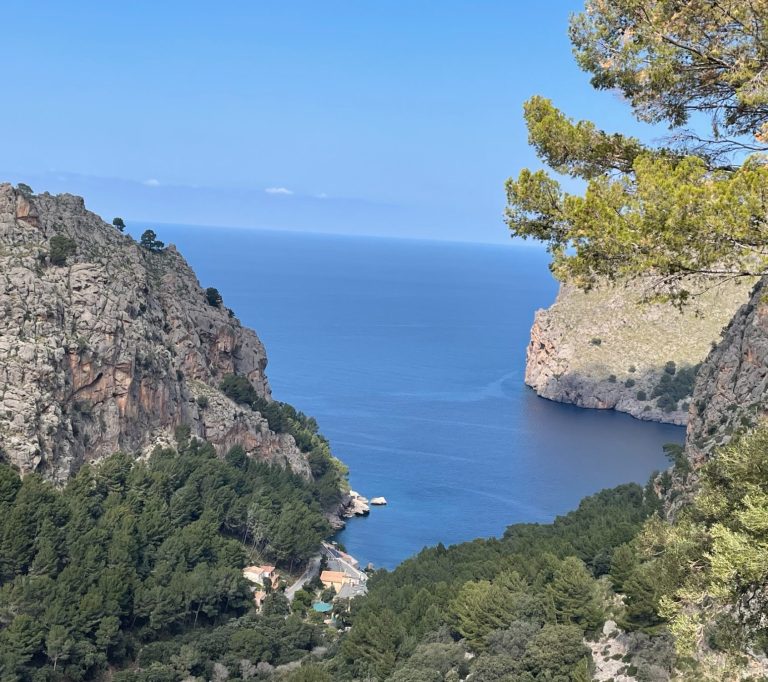
The road to Sa Calobra—a small village at the bottom—is carved into an arid gorge, winding through 26 hairpin bends and tight twists. Rocky cliffs rise on both sides, overlooking this famous road and creating its extraordinary scenery. The road itself only adds to the drama. Check out this video descending the road to Sa Calobra.
The climb back up to Coll dels Reis is 10.2 km long and gains 708 m of elevation. It is a phenomenal, truly unique road, twisting like a snake through the landscape, with sections reaching gradients of up to 10%. Once back at the top, and after a short ascent toward Puig Major, the descent back to Port de Sóller is a real treat. Check out this video descending from Puig Major.
The descent to Sa Calobra is busy and highly technical. Staying alert is essential for getting down safely, as accidents are not uncommon here.
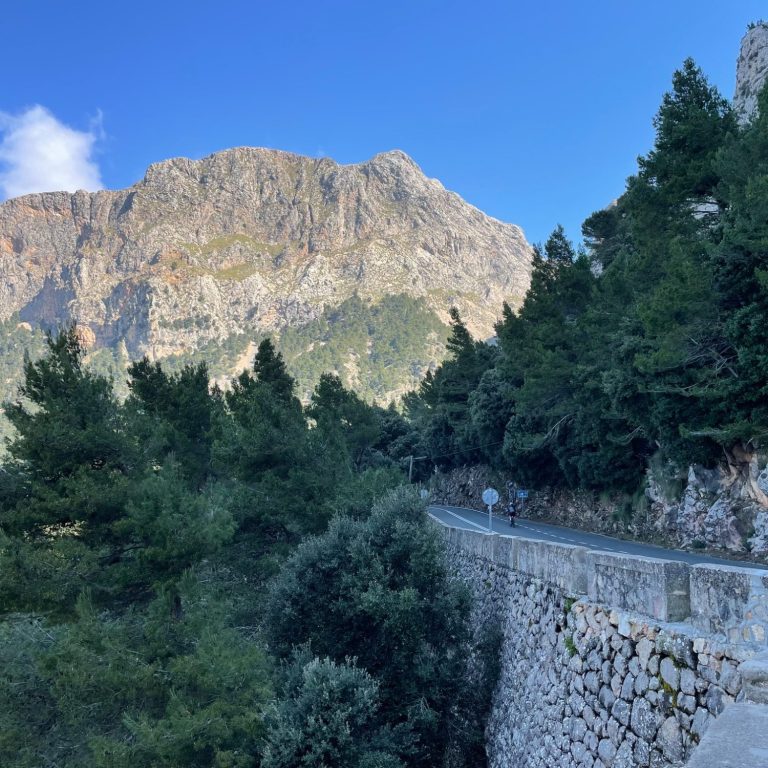
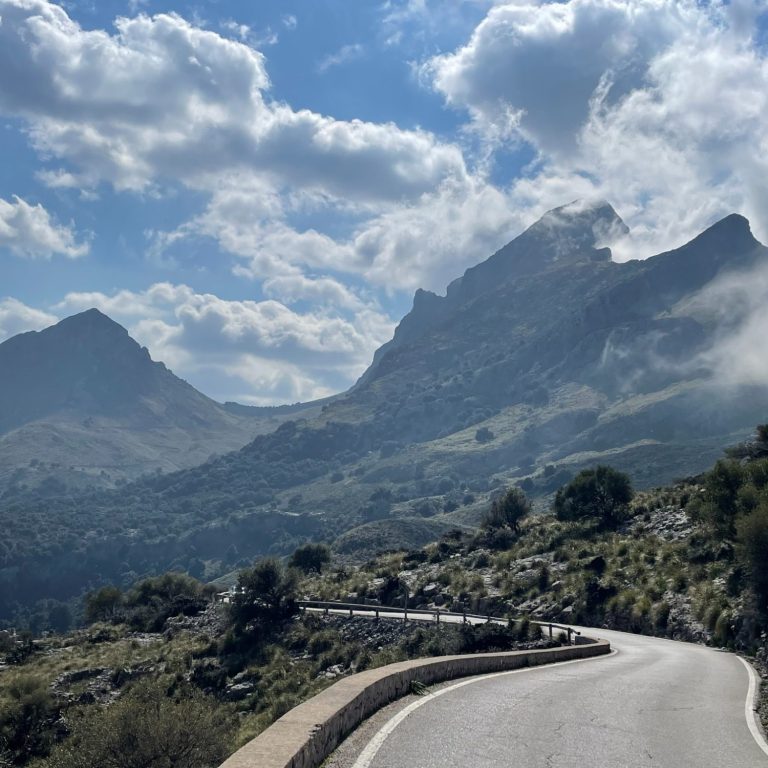
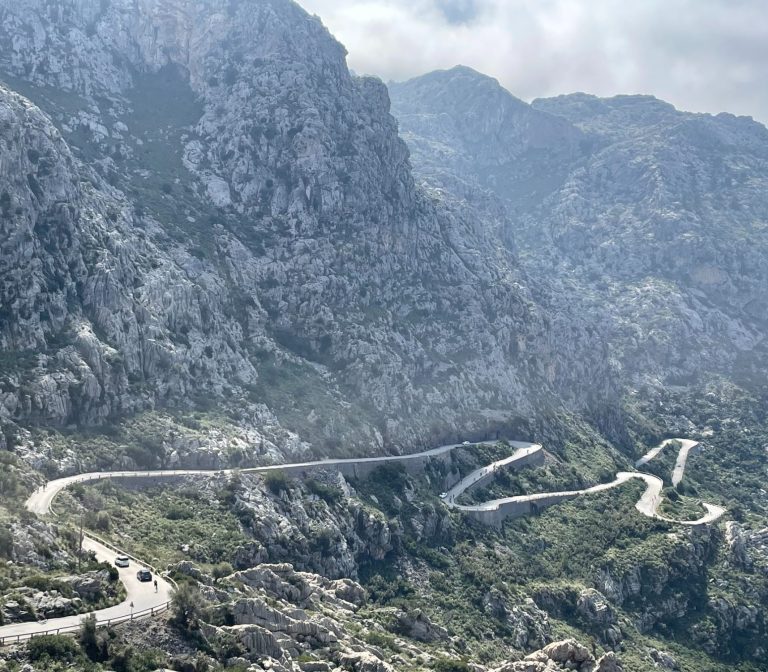
Inland from Port de Soller
All the Coll's
This route goes around and over the Puig Major. From Port de Soller, it climbs the Coll de Sóller - which is the sweetest climb - through around 30 hairpins before heading inland. It descends to the lovely village of Bunyola, then follows the quiet Ma-2100 backroad toward Orient and Alaró. The Coll d'Honor—a climb of around 390 m—lies between Bunyola and Orient, finishing with a series of tight switchbacks on a remote and rickety road.
From Alaró, the route continues along the Ma-2110 to Lloseta. From there, the Ma-2113 and Ma-2114 lead through the main valley to Selva and ultimately to Caimari, where the climb to the Coll de Sa Batalla begins, rising to 578 m.
This is a magnificent road passing pine forests at first followed by olive groves and climbing through a set of sweet switchbacks into a dramatic gorge, passing the striking Sa Bretxa Nova. It is a truly special place. From the Coll de sa Batalla, it is about 15 km to Puig Major, which open the most impressive views of the Tramuntana mountains and serve as a reminder why we ride our bikes.
The the final climb gaining around 275 m over 5 km past the Gorg Blau lake. The pass sits at an altitude of 885 m and the return to Port de Sóller is a fast downhill, with sweeping corner.
Overall, this ride is 97 km long and includes around 2,110 m of climbing.
The climb up to Coll de Sa Batalla and onward to the Sa Calobra turn-off is probably the busiest cycling route in Mallorca, with thousands of cyclists on the road during a day in peak cycling season, which can create very dangerous riding conditions.
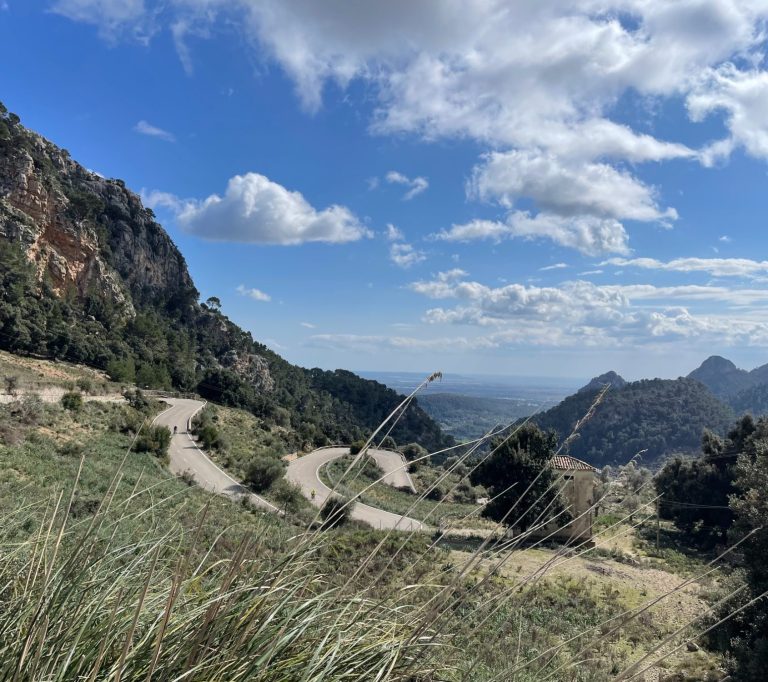
North Coast to the West of Port de Soller
Magical coast line
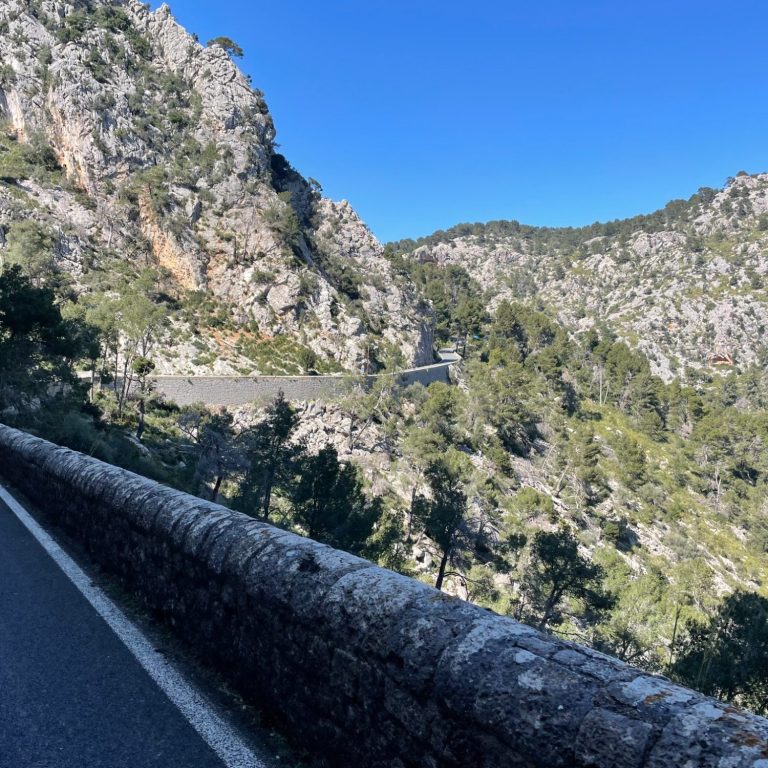
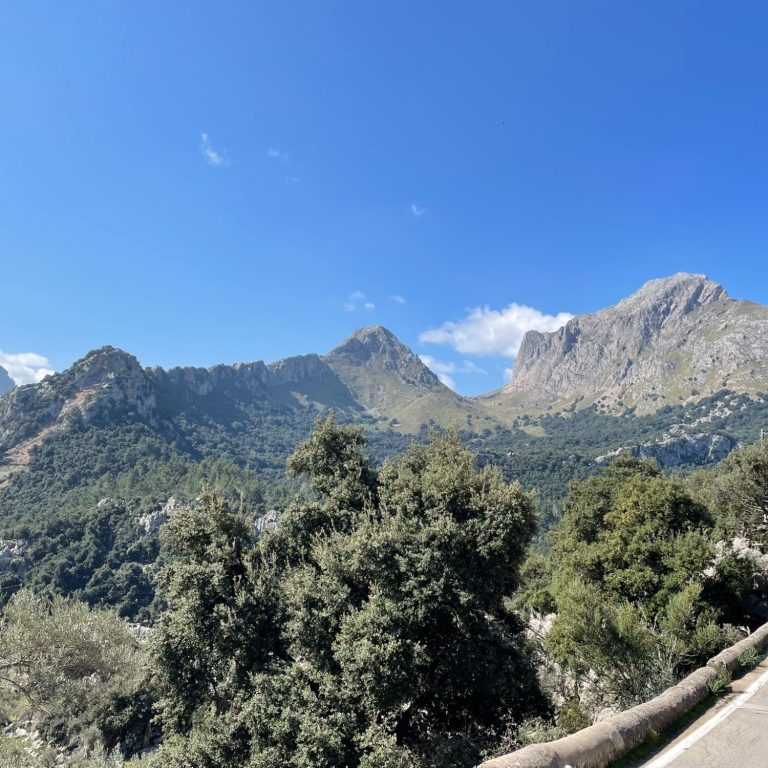
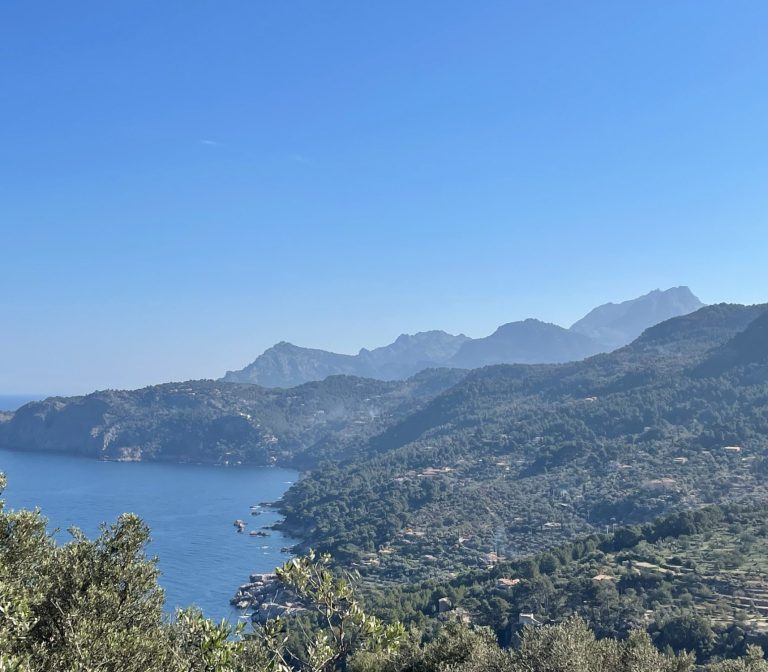
Taking the road west from Port de Sóller to Cala d’Estellencs makes for a 95 km ride with around 2,000 m of elevation gain. It is a beautiful, rolling route with five climbs dotted along the way, the highest reaching 498 m at the Coll de Claret. The coastline is as dramatic as any on the island, and the villages of Deià, Banyalbufar, and Estellencs are quaint, nestled against the cliffs rising behind them.
The road is constantly undulating, winding through lovely switchbacks, with stunning views of both the sea and the mountains.
It is truly a fantastic way to spend a day on the bike, and you won’t want the road to end.
There are also plenty of cafés and restaurants along the route, making this a ride to be savoured rather than rushed. Take the time to stop, admire the views, explore the villages, and enjoy this incredible road.🚴♂️
Coast and Mountains from Port de Soller
A bit of everything
This route combines the beautiful coastal road to Valldemossa with the steep descent to Port de Valldemossa and a climb of the Coll de Sóller.
The ride begins on a small, slightly rickety road leaving Port de Sóller and heading toward Fornalutx, which is a lovely spot for a coffee stop. After passing through Sóller, the route joins the scenic Ma-10 heading west, offering stunning coastal views and passing through the beautiful village of Deià followed by the climb to the Can Costa to 424m.
At Valldemossa, the road drops steeply down 366m to the coast at Port de Valldemossa, adding some extra climbing and dramatic coastal scenery. The route then returns to Valldemossa itself before turning inland. From Bunyola, the climb over the Coll de Sóller begins with its 26 hairpin bends, followed by a well-earned descent back to Port de Sóller.
In total, the route is 84 km long and includes around 1,820 m of climbing, taking you through a wonderfully varied landscape of coastline and mountains. 🚴♂️
Climbs from Port de Soller
Epic Cycling Climbs in Mallorca around Port de Soller
875 m, Puig Major, Spain, pass connecting Soller and Lluc i Son Macip: From Soller, this is a 14.3km long climb covering 843m elevation gain and is the longest and highest climb on the island, locally known as "Tunel de Monnaber". Gradients are manageable with an average 6% and not more than 8%. The road takes you deep into the Tramuntana mountains and is almost hypnotic with its steady flow. The highest point is after the tunnel. The mountains here are the highest with the Puig Major at 1,436m providing a dramatic backdrop.
682 m, Coll dels Reis Sa Calobra, Spain, pass connecting Sa Calobre and the Ma-10 main road: The most famous climb on the island! The road to Sa Calobra—a small village at the bottom by the sea—is built through an arid gorge, winding through 26 hairpin bends and tight twists. Rocky cliffs rise on both sides, overlooking this famous road and creating its extraordinary scenery. The Nus de sa Corbata loop gives the road its trademark appearance. This is real bucket list stuff.
576 m, Coll de Sa Batalla, Spain, pass connecting Caimari and the Ma-10 main road: The climb is part of the southern ascent to the Puig Major pass and on the route to Sa Calobra. From Caimari, it is 9.2km long and covers 435m elevation gain. The road weaves through a great gorge with dramatic views, there are lovely forests, switchbacks and open vistas. This is one of the nicest roads on the island. At the top is a gas station with a bike friendly cafe to refuel.
555 m, Coll d'Honor, Spain, pass connecting Bunyola and Orient: This is a real backroad on the southern side of the Tramuntana range through a quiet valley. As you leave Bunyola, it gets quiet very quickly and there is nothing by the roadside till you reach Orient. A lovely climb in solitude - especially in the off season - marked by an unremarkable sign that you have arrived which is in contrast to the fabulousness of this ride.
497 m, Coll Soller, Spain, pass connecting Soller and Bunyola: Lovely climb out of Soller with over 30 hairpins and rising 473m over a 9km distance. The tunnel takes all the traffic and the road is very quiet. The road rises through a reasonably tight valley with lush vegetation covering seemingly endless amounts of hairpins. This is a fantastic climb - switchback heaven.
424 m, Can Costa, Spain, pass connecting Deia and Valldemossa: A 6.5km climb from Deja rising 302m which seems light on average but the first 3km pack a punch before it levels off towards the top. Hemmed in between the sea on the right and the mountain on the left overhead, this is a lovely ride all round. Valdemossa at the end of the road is a great destination.
370 m, Port de Valldemossa, Spain, road connecting Port de Valldemossa and Valldemossa: Now that is a road to saviour. Steep, tight, dramatic. It drops from Valldemossa - more precisely from the Ma-10 main road - to the Port de Valldemossa through a tight valley and 10 dramatic switchbacks and turns. At the bottom is a small fishing village in a tight cove with fabulous views out to see and up the hill. The road is 5km long and climbs 366m which makes this one of the steeper roads on the island.
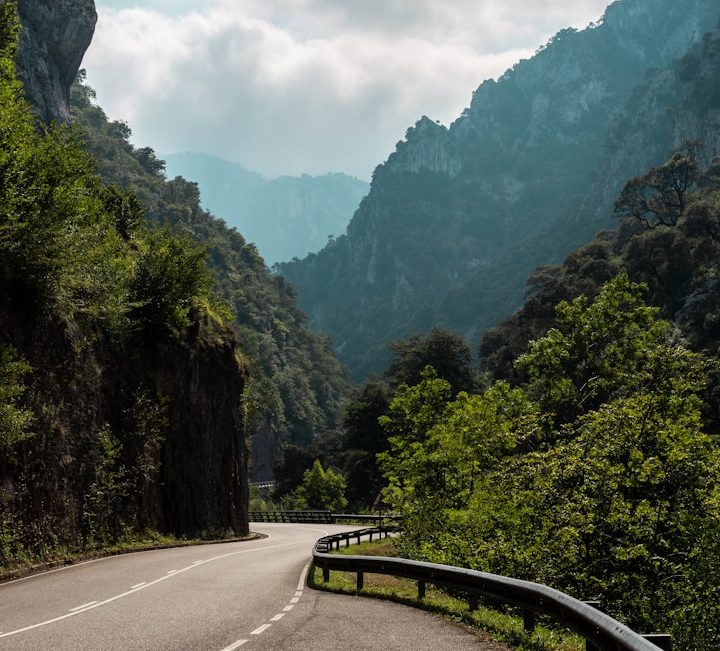
Discover further riding in Spain with Komoot
Legendary climbs - Ports of La Vuelta a España. Explore more here.
More riding in Mallorca. Explore more here.
Great mountain passes of Picos de Europa on road bikes. Explore more here.
Ports and Roads — Catalonia on Wheels. Explore more here